

You know how the hardest part of trying something new in bed is rarely the thing itself, it’s the conversation beforehand.
If you want to introduce kink to a partner, the safest way to do it is to treat it like any other relationship topic: clear consent, clear language, and small, reversible steps. That matters even more if you’re planning to bring in sex toys UK couples often start with, like a blindfold, a vibrator, or simple couple sex toys.
A YouGov survey published in 2015 found that 27% of Brits aged 18 to 39 said they’d like to try BDSM, and 19% said they already had. That tells you two things: you’re not “odd” for being curious, and you still can’t assume your partner will be into the same things.
So, I’m going to walk you through how to prepare, how to start the chat, how to set limits (including safewords), and how to use aftercare so nothing feels like a gamble.
Key Takeaways
- Keep it ethical and emotionally safe: use enthusiastic consent, a safeword or stoplight system, and aftercare.
- Sort “nice-to-have” from “need-to-have” before you talk, using a simple 1 to 5 scale and a yes/no/maybe list.
- Start with low-risk trial steps (dirty talk, light bondage toys, sensory play) and review together before you escalate.
- Respect a no immediately, avoid pressure, and consider kink-friendly support if you get stuck, including guidance often discussed by Kat Kova and Kesiena Boom.
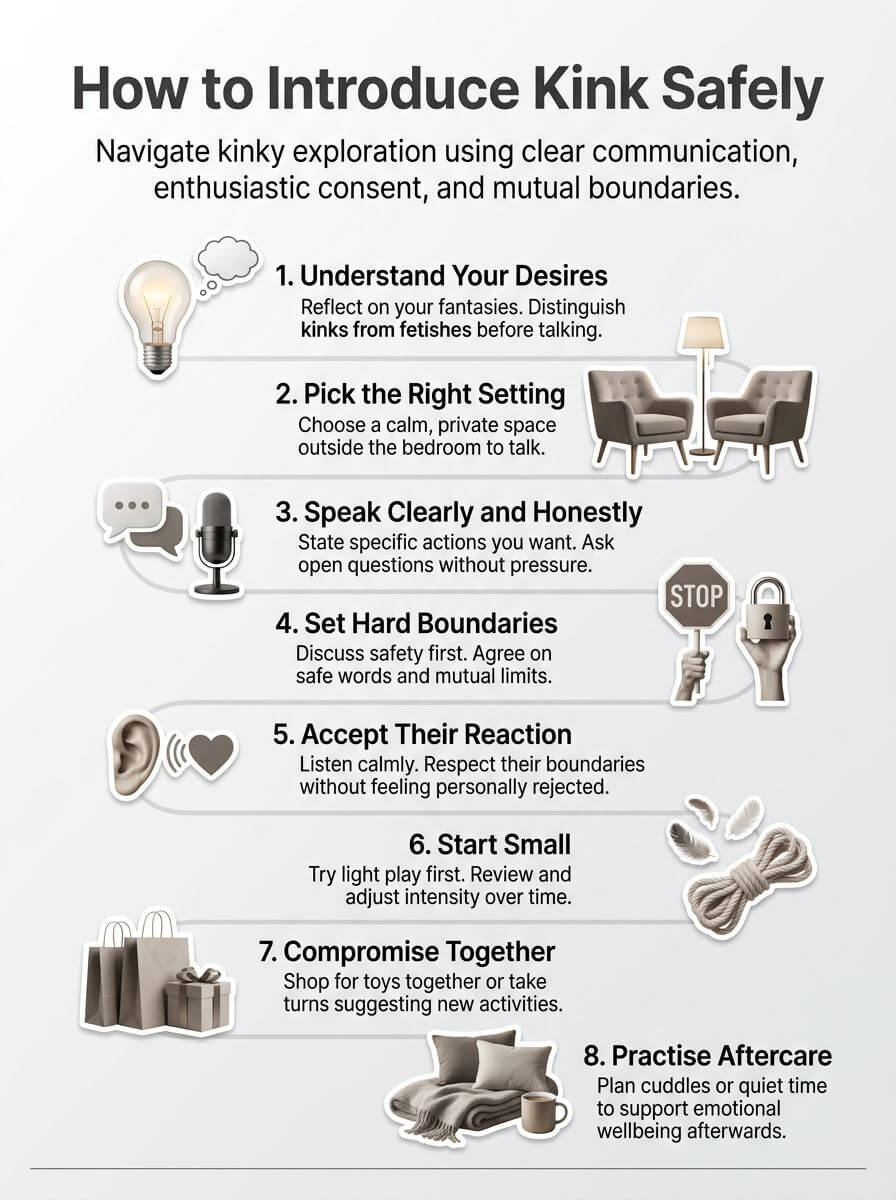
What exactly is a kink?
A kink is any consensual sexual interest that sits outside what you’d call “default” sex. That can be a dynamic (dominance and submission), a sensation (impact play), a scenario (voyeuristic play), or a specific style of touch (erogenous zones exploration).
The word itself has a practical history. Etymology references trace “kink” to a nautical term linked to Dutch for a twist in a rope, and the sexual meaning shows up much later in modern English.
The key point is this: a kink can be part of your sexual activity without becoming your whole identity. You might enjoy BDSM, shibari, orgasm control, humiliation, dirty talk, sploshing, wet and messy play, or rope bondage, and still have plenty of “vanilla” sex that feels just as intimate.
If you’re buying gear, treat toys as tools, not as proof you’re “serious”. Many kinksters start with simple bondage toys, a ball gag, or a beginner restraint set, then learn what actually feels good in real life.
How is a kink different from a fetish?
In plain terms, a kink is usually an optional enhancer. It’s an action, dynamic, or flavour that boosts sexual pleasure, like spanking, foot worship, domination, or a dom/sub scene.
A fetish is often more object-centred. The arousal may focus on a specific body part or thing (foot fetishes, podophilia, hair fetishism, scent or smelling cues, a yoni egg, a particular fabric). Some fetishists feel they strongly prefer, or even need, that focus to feel aroused.
Clinical definitions draw an even more important line: the DSM-5 framework distinguishes atypical interests from a disorder. A fetishistic disorder diagnosis requires persistence (often described as six months) and significant distress or impairment, not just “my partner isn’t into it”. If your interest causes distress, harms your life, or pushes you towards non-consensual situations, that’s the moment to seek professional help.
Dr Aliyah Moore’s quick self-check is a decent starting prompt for your own reflection: “Am I aroused by a thing or an action?”, “Do I need it present to be aroused?”, and “Can I enjoy solo sex without it?” Treat any quiz result as information, not a label.
Why should couples talk openly about kink?
Because talking first is how you keep it fun.
A good kink conversation lowers risk. You can name hard limits before you try sexual practices like impact play, orgasm denial, consensual humiliation, or restraints. You can also agree how you’ll pause, stop, and check in, so consent stays active.
It also protects intimacy. Secrets create distance. A sex-positive conversation turns “private fantasy” into “shared option”, and it gives you a way to talk about feeling safe, not just feeling turned on.
One practical relationship tool that transfers well here is the “soft start-up”, a concept popularised in Gottman-style couples work. Start gently, stay specific, and focus on what you want, not what your partner is doing wrong. It changes the whole tone of the chat.
- Before: “Why don’t you ever do anything kinky?”
- After: “I’d love to share something that turns me on. Could we talk about it for ten minutes, with no pressure to act on it?”
Preparing to talk about kink (including sex toys UK basics)
Preparation is what keeps this from turning into a confession, a demand, or a surprise “test”.
Start by getting clear on what you want to try, what you don’t want, and what would make you feel emotionally safe. If you want to bring in sex toys or adult sex toys, decide whether they are a nice-to-have, or central to the fantasy.
Then choose a simple safety framework you can both understand. Many BDSM communities talk about consent philosophies like SSC (safe, sane, consensual) and RACK (risk-aware consensual kink). The acronyms matter less than the habit: you talk about risks before you act.
How can I reflect on my desires?
Your goal is to describe your kink clearly enough that your partner can give real consent.
- Separate “thing” from “action”: Are you excited by an object/body part (fetish), or a scenario/dynamic (kink)?
- Use a 1 to 5 scale: Rate each desire from “curious” to “need”. That stops you overselling a fantasy you only want to try once.
- Write a yes/no/maybe list: Pick 20 to 30 items (bondage, blindfolds, dirty talk, role play, foot worship, orgasm control) and tick what feels safe, what’s a hard no, and what’s “maybe later”.
- Decide fantasy vs enactment: Some ideas work best in your imagination. You can enjoy the fantasy without turning it into a scene.
- Choose your first “trial step”: Make it small and reversible, like a script for dirty talk, a blindfold, or using a vibrator together.
- Flag medical and safety exclusions: Be honest about asthma, panic triggers, trauma history, blood pressure issues, or anything that affects pain, breath, or circulation.
If you’re drawn to rope bondage (shibari or kinbaku), treat it as a skill, not a shortcut. Anatomie Studio in London has been running since 2015 and describes itself as the UK’s first full-time shibari educational space, which is a good reminder that education and consent culture are part of the practice.
What questions or concerns might my partner have?
Assume your partner’s first questions will be about safety, meaning, and pressure. That’s normal.
- “Is this safe?” Be ready to explain your plan for limits, safewords, and aftercare.
- “Does this change how you see me?” Reassure them: the kink is an option, not a new requirement for having sex.
- “Will you accept a no?” Say it clearly: “Yes. I’m bringing this up to talk, not to push.”
- “Are you unhappy with our sex life?” Frame it as expansion, not replacement. Name what already works.
Some partners also worry about what a kink “means” psychologically, especially with labels like paraphilia, spectrophilia, klismaphilia, or cuckolding. Keep it grounded: if everyone is consenting and it improves connection, it can be healthy. If it causes distress, compulsive behaviour, or repeated conflict, that’s a good reason to speak to a qualified sex and relationship therapist, including practitioners listed through COSRT.
- “What about porn or media?” Agree what ethical porn means for you both, and what you do not want in your relationship.
- “What about physical harm?” Be specific about what you will not do (for example, anything that risks injury, breath restriction, or lasting marks) unless you both understand the risks and still choose it.
How to introduce the conversation about kink
Pick a calm time, in private, when neither of you is rushed. Start outside the bedroom. That reduces pressure and helps your partner answer honestly.
Then name the desire in plain language. One kink, one sentence. You can mention examples like bondage, dirty talk, a ball gag, or trying couple sex toys. Keep it concrete, not performative.
- Try: “I’ve realised I’m curious about dominance and submission. Would you be open to talking about it?”
- Try: “I’d love to try some light bondage toys with you, starting very gently. Is that something you might enjoy?”
If it helps, borrow a useful relationship standard: Dan Savage’s “GGG”, good, giving, and game, within reason. “Within reason” is the part that protects both of you. Your yes can be enthusiastic. Your no can be final.
When and where is the best time to talk?
Choose a moment that already feels emotionally connected, like a quiet evening at home or a walk where you can talk side-by-side. Avoid starting the conversation mid-argument or mid-sex.
If you want to use texts first, keep it low-pressure. Hint at the topic and ask for a chat later, instead of sending explicit instructions or surprises.
- Text idea: “I’ve got something sexy I’d like to share. Can we talk tonight, no pressure to act on it?”
How do I use open and honest language?
Avoid vague hints. Vague language forces your partner to guess, and guessing kills consent.
Use “I” statements, keep your tone non-judgemental, and ask open questions. Then pause and listen.
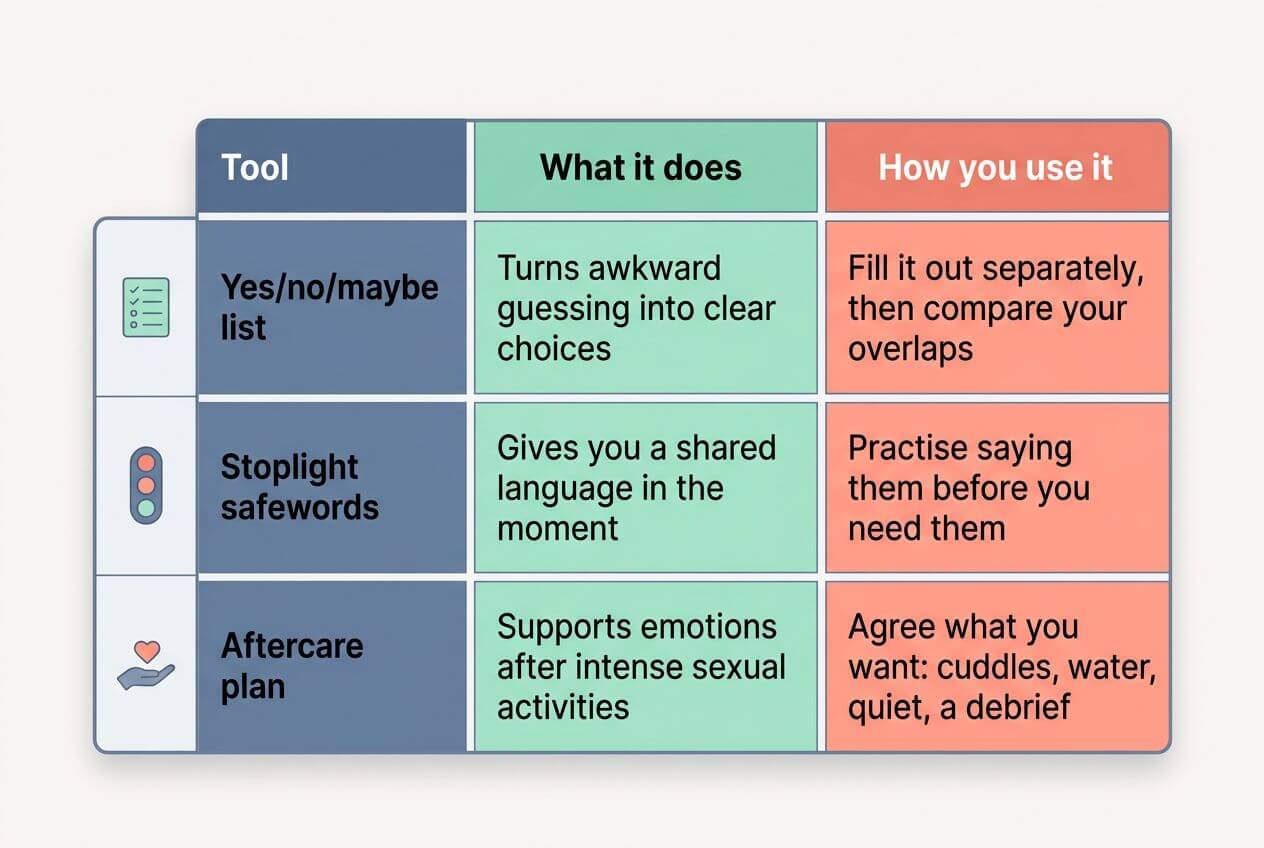
Set a safety system early. The simplest is the stoplight safeword approach: red means stop, amber means slow down or check in, green means all good. If you’re using a gag (bit gag or ball gag), agree a non-verbal signal, such as dropping an object from your hand or tapping three times.
| Tool | What it does | How you use it |
|---|---|---|
| Yes/no/maybe list | Turns “awkward guessing” into clear choices | Fill it out separately, then compare your overlaps |
| Stoplight safewords | Gives you a shared language in the moment | Practise saying them before you need them |
| Aftercare plan | Supports emotions after intense sexual activities | Agree what you want: cuddles, water, quiet, a debrief |
How can I cope with fear of rejection?
Fear of rejection is usually fear of what the answer “means”. So name the fear out loud, then separate the meanings.
A partner can reject a specific kink without rejecting you. Treat their response as information about fit, comfort, and timing.
If you spiral, shrink the ask. Instead of “Will you do BDSM with me?”, try “Would you talk about fantasies with me?” or “Would you try one small thing once, like dirty talk or a blindfold?”
If anxiety is overwhelming, kink-friendly therapy can help you talk about sexuality without shame. COSRT’s therapist register is one UK starting point for finding a trained sex and relationship therapist.
How should I respond to my partner’s reaction?
Match their pace. If they’re curious, keep it simple. If they’re unsure, slow down. If they’re distressed, stop and reassure.
- If they say yes: Agree one small trial step, one boundary, one safeword system, and one aftercare plan.
- If they say maybe: Offer neutral information, then give them time. Set a date to revisit it so it doesn’t hang over you both.
- If they say no: Accept it cleanly. Thank them for being honest, and move on without punishment, sulking, or repeated “selling”.
Why is it important to respect their boundaries?
Because boundaries are the foundation of trust, and trust is what makes kink feel safe.
There’s also a legal and safety reality in the UK: the Government has reiterated the principle from the 1993 case R v Brown that consent is not a defence to assault causing actual bodily harm (or worse), even where people say it happened during sex. You do not want a “hot” moment to turn into an injury, a police report, or lifelong regret.
That’s why I push couples towards low-risk power exchange first. Make it about roles, words, and controlled sensation, not about harm.
Be extra cautious with erotic asphyxiation. NHS inform warns that pressure on the neck can lead to serious medical complications, and advises seeking urgent help if someone has trouble breathing, swallowing, or develops worrying symptoms after strangulation.
How can we explore compromises together?
Compromise works best when it’s structured. You agree a trial, run it, then review it like a team.
- Start light: Blindfolds, guided touch, role play, sensual domination, or a simple restraint you can release instantly.
- Make toys the “third object”: Shopping together for adult toys UK customers can buy discreetly (like couple sex toys, lubes, or a vibrator) keeps the focus on practical choices, not pressure.
- Time-box experiments: “Let’s try this for ten minutes, then we check in.” It’s simple, and it prevents panic.
- Use a two-minute debrief: Ask “What felt good?”, “What didn’t?”, and “What do you want next time?”
- Plan aftercare: Decide what helps each of you come down, such as water, a snack, cuddles, quiet, or reassurance.
- Keep hygiene non-negotiable: UK sexual health service SH:24 advises cleaning sex toys, and a practical rule is to wash toys after every use, let them dry fully, and use condoms on shared toys to reduce infection risk.
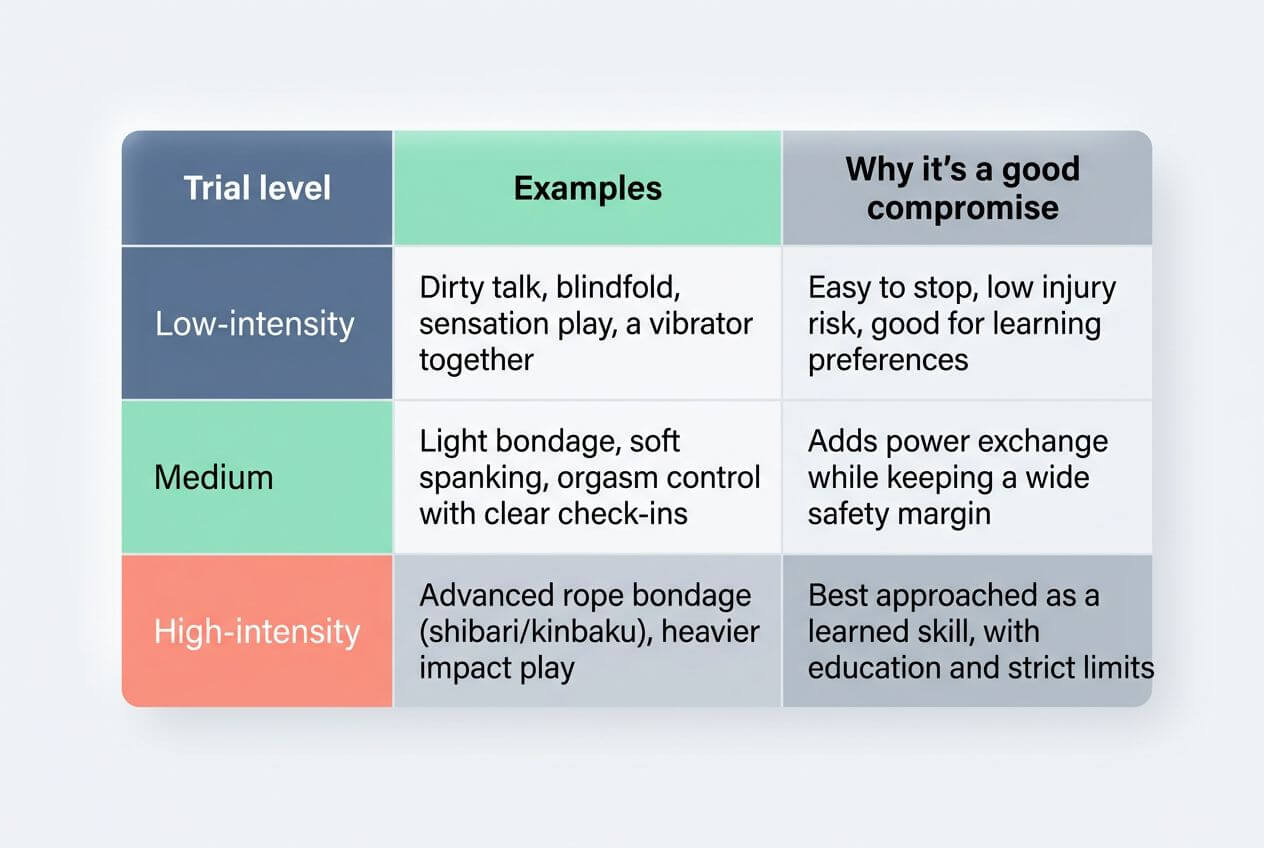
| Trial level | Examples | Why it’s a good compromise |
|---|---|---|
| Low-intensity | Dirty talk, blindfold, sensation play, a vibrator together | Easy to stop, low injury risk, good for learning preferences |
| Medium | Light bondage, soft spanking, orgasm control with clear check-ins | Adds power exchange while keeping a wide safety margin |
| High-intensity | Advanced rope bondage (shibari/kinbaku), heavier impact play | Best approached as a learned skill, with education and strict limits |
If you want a simple place to start shopping, For The Closet lists a wide range of adult sex toys, bondage gear, and bedroom essentials. Use it as a menu for discussion, not as a shopping list you spring on your partner.
Conclusion
You protect your relationship by treating kink as a consent-led conversation, not a surprise request.
Start with small steps, use safewords and aftercare, and respect a no without debate. If you’re bringing in sex toys UK couples often use, keep it simple, hygienic, and mutual.
Done well, kink becomes another way to build intimacy and trust, not something that “ruins things”.
FAQs
1. How do I introduce kink to a partner?
Pick a calm time and ask to talk, use plain communication and honest words. Explain what interests you and why, and listen to their view. Use kink negotiation to set clear consent and firm boundaries.
2. What if my partner is unsure or says no?
Respect their answer and do not press. Offer clear information, and suggest small steps only if they show interest.
3. Will trying kink harm our trust or relationship?
Research shows negotiated kink can build trust. It need not harm your bond if you use consent and open talk. Use safety checks, a safe word and aftercare, then review how you both felt.
4. How do we keep kink safe?
Use clear consent, a safe word, agreed limits, proper safety measures and plan aftercare.